
T-FLOC™ FLOCULATION TUBE
T-FLOC™ is INFRACORP’s compact flocculation tube system, designed to provide efficient, controlled floc formation in a small footprint compared to conventional mechanical flocculators. It uses a hydraulic mixing regime to enhance the coagulation–flocculation process, ensuring optimal particle collision and growth without moving parts.
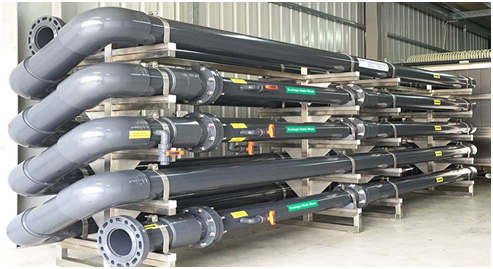
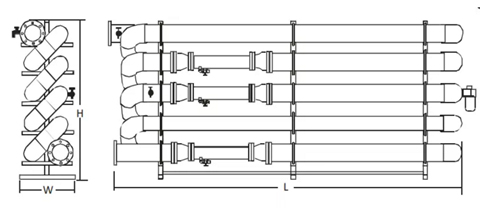
T-FLOC™ is INFRACORP’s compact flocculation tube system, designed to provide efficient, controlled floc formation in a small footprint compared to conventional mechanical flocculators. It uses a hydraulic mixing regime to enhance the coagulation–flocculation process, ensuring optimal particle collision and growth without moving parts.
Theory Of Operation
Tube Flocculator is a unit operation used in WTP and WWTP. The tube flocculator is a plug flow reactor in which processes such as coagulation, flocculator, demulsification, precipitation and pH control can take place under highly controlled and well defined conditions. The mixing action in the floc tube is achieved in the turns, constrictions, and expansions. The restriction and expansion of pipe size causes additional turbulence and numerous eddies in the flow pattern. These eddies, when combined with the changes in flow direction at the elbows, disrupt the velocity gradient and flow patterns, providing significant radial mixing as well as axial back mixing. In addition, some radial and axial mixing is achieved in the straight sections due to the turbulence of the fluid in the pipe. NanoWater T-Floc™ tubes are sized so that flow in the straight sections is well into the turbulent flow regime (NRe>50,000)
Core Technology
T-FLOC™ employs a coiled or serpentine flocculation tube engineered to create uniform turbulence. As water flows through the tube:
- Coagulants and polymers are evenly dispersed.
- Gentle but effective mixing encourages microflocs to grow into dense, settleable flocs.
- The process is fully hydraulic, requiring no mechanical agitators or power.
This makes T-FLOC™ a robust, low-maintenance alternative to traditional flocculation basin
INTEGRATED WITH INFRACORP TECHNOLOGIES
BioMem™can be combined with:
- Reclaim™ — Advanced water reuse platform
- CLRO™ — High-recovery thermal-membrane hybrid RO
- ZeroFluoro™ — PFAS destruction and crystallization
- Min™ZLD — Compact Zero Liquid Discharge solution
Together, these technologies deliver complete and sustainable water cycle management for industries and cities
Contact us to learn more about our BioMem™
INFRACORP™ Membrane Bioreactor (MBR)
Advanced Biological Filtration for High-Purity Water Reuse
INFRACORP™ Membrane Bioreactor (MBR)
Next-Generation Biological Filtration for High-Purity Water Reuse
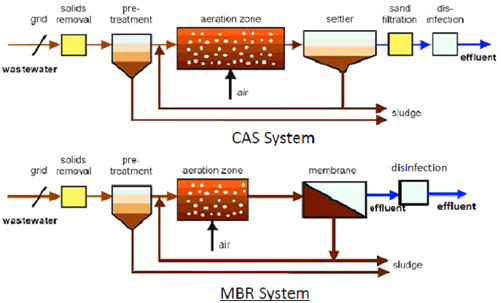
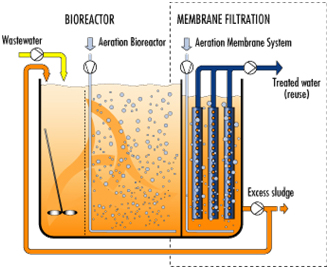
The INFRACORP™ Membrane Bioreactor (MBR) is a next-generation wastewater treatment platform that seamlessly combines biological degradation with membrane filtration to deliver exceptional effluent quality. By integrating an aerobic biological process with ultrafiltration or microfiltration membranes, the system effectively separates treated water from suspended solids and microorganisms, eliminating the need for conventional clarifiers.
Key Technology Features
- 🧬Integrated Biological & Membrane Filtration:
The MBR process leverages a high concentration of active biomass to degrade organic pollutants, followed by membrane filtration to achieve superior solid-liquid separation. This results in crystal-clear effluent with very low turbidity and near-zero suspended solids. - 💧High-Quality Effluent for Reuse:
The system consistently achieves BOD < 5 mg/L, TSS < 1 mg/L, and turbidity < 0.1 NTU, making it suitable for direct discharge or reuse in industrial cooling, irrigation, or further polishing for potable applications. - 🏭Compact & Modular Design:
MBR systems operate at high mixed liquor suspended solids (MLSS) concentrations, allowing for a smaller biological reactor volume and reduced plant footprint compared to conventional activated sludge systems. - ⚡Operational Stability & Flexibility:
The robust process design maintains performance under fluctuating hydraulic or organic loads, ensuring stable treatment even in challenging industrial wastewater scenarios. - ♻️Reduced Sludge Production:
Higher solids retention time (SRT) improves biomass yield efficiency, minimizing excess sludge generation and lowering disposal costs. - 🧠Automated & Intelligent Control:
INFRACORP integrates smart monitoring and control systems to optimize aeration, backwashing, and cleaning cycles, reducing energy consumption and extending membrane life.
Applications
- Municipal wastewater treatment and reuse
- Industrial effluent treatment (chemical, food & beverage, pharmaceutical, textile, etc.)
- High-strength wastewater streams
- Advanced water reuse and recycling projects
- Integration with ZLD (Zero Liquid Discharge) and polishing systems
Why INFRACORP™ MBR
- Proven process reliability with stable long-term operation
- Scalable modular design — easy to expand capacity
- Seamless integration with other INFRACORP platforms (e.g., Reclaim™, ThermoRO™, ZeroFluoro™)
- Lower lifecycle cost due to reduced footprint and O&M requirements
- Effluent quality that exceeds global discharge and reuse standards
INFRACORP membrane bioreactor (MBR) is a wastewater treatment system that combines biological treatment with membrane filtration to produce highly purified wate
Good — let’s clarify exactly what you mean by “MBR membrane filter media.”
In the context of INFRACORP’s water and wastewater technologies, this refers to the membrane module or material used in a Membrane Bioreactor (MBR) system — typically for biological wastewater treatment with solid-liquid separation.
Here’s a breakdown of what MBR membrane filter media means and how it fits technically:
MBR Membrane Filter Media Overview
- Definition
MBR (Membrane Bioreactor) systems combine biological treatment (activated sludge) with membrane filtration (microfiltration or ultrafiltration).
The membrane filter media is the core separation component — it replaces traditional sedimentation by physically retaining solids and microorganisms, allowing only treated water to pass through.
- Types of Membrane Media
|
Type |
Material |
Configuration |
Typical Pore Size |
Advantages |
|
Flat Sheet (FS) |
PVDF, PES, or PTFE |
Plate-type panels |
0.1–0.4 µm |
Robust, easy cleaning |
|
Hollow Fiber (HF) |
PVDF, PES |
Bundled fibers |
0.03–0.1 µm |
High surface area, compact design |
|
Tubular |
Ceramic, PVDF |
Cylindrical tubes |
0.01–0.1 µm |
Handles high solids, easier maintenance |
|
Ceramic (Flat or Tubular) |
Alumina, zirconia |
Inorganic |
0.01–0.1 µm |
Long life, chemical/thermal resistant |
- Performance Characteristics
- Flux rate: 15–40 L/m²·h (depends on MLSS and TMP)
- Transmembrane pressure (TMP): 0.1–0.5 bar
- Typical MLSS concentration: 8,000–12,000 mg/L
- Cleaning: Air scouring + chemical cleaning (NaOCl, citric acid)
- Lifespan: 3–10 years (depending on material and operation)
- Role in INFRACORP Applications
If we align this with INFRACORP’s ecosystem, MBR membrane filter media would likely integrate with:
- BioSep™ (MBBR + membrane hybrid configuration)
- Min™ZLD™ (as a pre-polishing or polishing step before RO)
- Reclaim™ / HyO-RO™ (for tertiary or reuse treatment)
INFRACORP could use:
- PVDF hollow-fiber membranes for municipal and industrial reuse, or
- Ceramic tubular membranes for H2T™ (Hard-to-Treat) wastewater streams with high fouling loads.
- Example Specification (for reference)
|
Parameter |
Value |
|
Membrane type |
Hollow fiber PVDF |
|
Configuration |
Submerged module |
|
Pore size |
0.04 µm |
|
Nominal flux |
25–35 L/m²·h |
|
Operating TMP |
0.2–0.4 bar |
|
pH range |
2–10 |
|
Cleaning agents |
NaOCl, citric acid |
|
Lifespan |
5–7 years |
Would you like me to:
- ⚙️Design INFRACORP’s proprietary MBR media specification sheet (for BioSep™ integration)?
or - 📊Compare different membrane media options (PVDF vs. Ceramic vs. PES) to select the optimal one for your H2T™ or Min™ZLD™ applications?
You said:
is it dry or submerged?
ChatGPT said:
Excellent question — and very important for design.
In Membrane Bioreactor (MBR) systems, membrane filter media can operate in two main configurations — submerged (immersed) or external (dry/pressurized). The distinction has major implications for energy, footprint, and maintenance.
Here’s a clear comparison:
⚙️ 1. Submerged (Immersed) MBR
→ Most common type used in municipal and industrial wastewater MBRs today.
✅ Description
- Membrane modules are submerged directly in the bioreactor tank or in a separate membrane tank.
- A vacuum or slight suction pressure pulls treated water through the membrane.
- Air scouring is used to control fouling and provide oxygen to biomass.
💧 Key Features
|
Parameter |
Typical Value |
|
Filtration driving force |
Negative pressure (suction) |
|
TMP |
0.05–0.5 bar |
|
Energy use |
0.3–0.6 kWh/m³ |
|
Cleaning |
Periodic backwash + air scouring |
|
Footprint |
Compact, modular |
|
Maintenance |
Easy (in situ cleaning) |
🌿 Best suited for
- Municipal and industrial wastewater
- Moderate-to-high MLSS (8,000–12,000 mg/L)
- BioSep™ or Min™ZLD™ applications
✅INFRACORP’sBioSep™ system (using NanoChip™ media) would typically employ submerged MBR membranes, because it integrates biological and physical separation in one compact tank.
🔩 2. External (Sidestream / “Dry”) MBR
→ Pressurized, membrane modules are outside the bioreactor.
💧 Key Features
|
Parameter |
Typical Value |
|
Filtration driving force |
Feed pump pressure |
|
TMP |
1–3 bar |
|
Energy use |
1–2 kWh/m³ (higher) |
|
Cleaning |
Easier chemical cleaning (offline) |
|
Footprint |
Larger (extra pumps/piping) |
|
Maintenance |
More complex (but accessible) |
🌿 Best suited for
- High-strength industrial wastewater (oils, solids)
- Smaller flows requiring high flux
- When cleaning downtime is acceptable
In INFRACORP’s H2T™ or ZeroFluoro™ systems (treating very challenging effluents), an external/dry MBR configuration could be used before or after chemical oxidation — but generally as a niche or modular side unit, not the main biological reactor.
🧭In summary
|
Configuration |
Typical for |
Used in INFRACORP systems |
Energy |
Maintenance |
|
Submerged MBR |
Municipal, mixed industrial |
BioSep™, Min™ZLD™ |
Low |
Simple, in-tank |
|
External (Dry) MBR |
High-fouling, high-solid |
H2T™, ZeroFluoro™ pre/post stages |
High |
Offline |
👉Answer:
INFRACORP’s MBR membrane filter media would typically be submerged (immersed) type — integrated within the bioreactor (BioSep™), providing compact, low-energy, and easily maintainable operation.
Would you like me to draft a technical spec sheet and diagram for INFRACORP’sSubmerged MBR Module (membrane + NanoChip™ hybrid)? It would include design layout, operating parameters, and material selection for your investor and engineering documentation.
You said:
pls do
ChatGPT said:
Thought for 4 seconds
Infra Corp Bio Sep Submerged Mbr Spec Sheet
INFRACORP — BioSep™ Submerged MBR Module
Document purpose: Technical specification sheet and schematic diagram for the Submerged Membrane Module to be used in the BioSep™ MBBR+MBR hybrid system. Suitable for engineering, pilot procurement, and investor technical appendix.
- Summary (1‑line)
A compact, submerged PVDF hollow‑fiber membrane module designed for integration with the BioSep™ moving‑bed biofilm reactor (MBBR) for high‑rate biological treatment and tertiary solids separation.
- Intended application
- Industrial and municipal wastewater tertiary treatment
- Hard‑to‑treat (H2T™) industrial effluents as polishing unit
- Prefiltration before reverse osmosis (Min™ZLD™, HyO-RO™) or for direct reuse
- Key design choices (rationale)
- Configuration: Submerged (immersed) modules inside membrane tank for low energy and compact footprint.
- Membrane type: PVDF hollow fiber, hydrophilic modified surface (robust to fouling, good chemical resistance).
- Pore rating: 0.03–0.04 µm (ultrafiltration) — balances virus/bacteria removal and acceptable flux.
- Cleaning strategy: Continuous air scouring + intermittent backpulse + chemically enhanced CIP (NaOCl, citric acid).
- Target flux: 20–30 L/m²·h (nominal) depending on MLSS and aeration design.
- Typical module specification (recommended baseline)
|
Item |
Value / Option |
|
Membrane material |
PVDF (hydrophilic coating) |
|
Configuration |
Hollow-fiber, submerged, bundled modules |
|
Module membrane area |
40–60 m²/module (typical commercial modules) |
|
Pore size (nominal) |
0.03–0.04 µm |
|
Nominal permeability |
200–400 L/m²·h·bar (clean water) |
|
Operating TMP |
0.05–0.35 bar (suction-driven) |
|
Nominal flux |
20–30 L/m²·h (design) |
|
Max. allowable flux (short-term) |
40 L/m²·h |
|
Operating temperature |
4–45 °C |
|
pH range |
2–10 (short excursions) |
|
Module housing |
PVDF / SS316 support frame |
|
Connections |
Integrated permeate headers, quick-release couplings |
- Typical operating parameters (system-level)
- Design flow (example): scalable — use area sizing method (see Section 7)
- MLSS in membrane tank: 8,000–12,000 mg/L (BioSep™ optimized)
- Air scour rate (coarse + fine): 0.5–2.5 m³/h·m² membrane (adjusted for fouling)
- Hydraulic retention time (MBR tank): 2–6 hours (process dependent)
- Backwash frequency: 5–30 min intervals (short backpulse 5–15 s) + periodic longer backwash
- CIP frequency: 1–4 months (based on TMP trend and flux decline)
- Cleaning chemicals & procedures (recommended)
Daily / Routine
- Air scouring continuous during operation to limit cake buildup.
- Short permeate backpulse every 10–30 min (configurable).
Chemical maintenance
- Sodium hypochlorite (NaOCl, 200–1,000 ppm) — for organic fouling, up to 1–2 hours. Ensure membrane manufacturer compatibility for chlorine exposure.
- Citric acid (1–2% w/v) — for inorganic scaling removal following NaOCl.
- Alkaline cleaners (e.g., NaOH 0.5–1% w/v) — for proteinaceous fouling when necessary.
CIP best practice
- Isolate modules and perform low‑pressure rinse.
- Apply alkaline/oxidative wash per manufacturer limits.
- Rinse thoroughly to neutral pH.
- Apply acid wash if scaling detected.
- Final rinse and integrity check.
Always follow membrane supplier chemical exposure limits.
- Sizing methodology (membrane area calculation)
Step 1 — Determine daily permeate volume (Qdaily)
- Example: Q_daily = 1,000 m³/day (pilot)
Step 2 — Convert to average design flux (J_design)
- Use conservative flux = 25 L/m²·h = 0.025 m³/m²·h
Step 3 — Calculate required membrane area (A_req)
- A_req (m²) = Q_daily (m³/day) / (J_design (m³/m²·h) × 24 h/day)
Example calculation
- A_req = 1,000 / (0.025 × 24) = 1,000 / 0.6 = 1,667 m²
Step 4 — Module count
- If module area = 50 m²/module → Modules = 1,667 / 50 = 33.3 → 34 modules
Design margin: Add 15–25% spare membrane area for fouling/aging. For this example use +20% → 1,667 × 1.20 = 2,000 m² (→ 40 modules at 50 m²/module).
- Hydraulic & pneumatic utilities
- Permeate suction pumps: Vacuum or low-pressure suction with redundancy (1 duty + 1 standby) sized for permeate flow.
- Air blower: Fine/coarse bubble aeration for scouring and process oxygen; variable speed recommended.
- Backpulse air/water system: Pulsed compressed air for permeate backpulse and scouring.
- Valving & instrumentation: Permeate flow meters, TMP gauges for each module rack, dissolved oxygen sensor, MLSS probe, pH/ORP sensors.
- Structural & materials
- Membrane tank: Concrete or GRP/HDPE with corrosion-resistant internals.
- Support frames: SS316 or coated carbon steel.
- Permeate header piping: PVDF, HDPE, or PE100 for chemical resistance and leak prevention.
- Accessibility: Modular racks with removable modules for offline service.
- Integration with BioSep™ MBBR
- Configuration: Membrane tank can be integrated downstream of the MBBR or as a combined MBBR + submerged MBR (biomass carriers plus membranes in same tank) depending on footprint and fouling tolerance.
- Carrier interaction: Use low-density NanoChip™ carriers to avoid direct abrasion on hollow fibers; baffle/guard rails recommended to prevent carrier–module contact.
- Process sequencing: MBBR (high-rate bio removal) → Membrane polishing (TSS & pathogen removal) → RO (optional) → Min™ZLD™
- Monitoring & automation
- Key alarms / KPIs: TMP rise rate, permeate turbidity, permeate flow, air blower pressure, MLSS, DO.
- Control strategy: Automatic backpulse scheduling, CIP initiation on TMP setpoint, aeration control via DO/airflow feedback.
- Procurement & vendor considerations
- Membrane vendors (examples to evaluate): Kubota, Toray, Pentair (Membrane Solutions), Norit (subsidiaries), MANN+HUMMEL, SUEZ (membrane division). Check PVDF hollow-fiber offerings and supplier chlorine tolerances.
- Purchase scope: Modules + racks, permeate piping & headers, air scour system, backing frames, instrumentation package.
- Example BOM (pilot — 1,000 m³/day scaled)
- 40 × 50 m² PVDF hollow-fiber modules
- Permeate header assembly and quick-connect couplings
- 1 duty + 1 standby permeate pump (mag-drive) 20–30 m³/h
- Air blower 30–60 m³/h (variable speed)
- DO, MLSS, pH probes, TMP gauges
- CIP skid (chemical dosing, recirculation pump)
- Performance targets & acceptance tests
- Initial acceptance tests: Integrity check, leak test, permeability test (clean water), biological performance in situ.
- KPIs: Permeate turbidity <1 NTU (typical), SDI <3 (pre-RO spec), TMP trend stable (<0.1 bar increase per month with routine cleaning)
- Maintenance schedule (recommended)
- Daily: Visual checks, permeate flow, TMP logging.
- Weekly: Permeate quality log, short CIP checks if required.
- Monthly: Chemical clean (if TMP trending upward) or targeted cleaning of modules.
- Quarterly: Inspect module integrity, replace gasket/quick connectors as needed.
- Annual: Performance audit and plan for membrane replacement (pro-rata based on fouling).
- Safety & environmental considerations
- Chemical handling procedures for NaOCl, acids, and alkalis; neutralization of CIP effluents; PPE for operators.
- Disposal routes for spent membranes (follow local regulations for polymer disposal) and for CIP effluent neutralization.
- Open items / next steps
- Confirm target design flow (pilot vs. commercial scale).
- Choose specific membrane vendor and obtain material compatibility sheets (chlorine exposure limits, warranty terms).
- Pilot test plan: 2–3 month operation with TMP trend logging and fouling characterization.
Appendix A — Simple P&ID (text schematic)
[ MBBR ] —> [ Membrane Tank (submerged) ] —> Permeate Pump —> Permeate
| |
Air Scour Permeate Header
| |
Blower Backpulse Air/Wtr
Prepared for INFRACORP — BioSep™ technical appendix. For engineering drawings (CAD/P&ID) and vendor datasheets, supply target flow and preferred membrane vendor and INFRACORP will finalize procurement drawings.
Done — I created the INFRACORP — BioSep™ Submerged MBR Module technical spec sheet and schematic in the canvas (titled Infra Corp Bio Sep Submerged Mbr Spec Sheet).
It includes:
- Module & membrane specs (PVDF hollow-fiber baseline)
- Operating parameters and cleaning/CIP procedures
- Sizing method with an example (1,000 m³/day → 2,000 m² with 20% margin)
- BOM for a pilot, integration notes with BioSep™, monitoring & automation, and maintenance schedule
- Simple P&ID text schematic and next steps for piloting and vendor selection
If you want, I can now:
- Convert the spec into a CAD-ready P&ID or PDF datasheet, or
- Produce vendor-ready procurement sheets (line items + spec templates), or
- Create an engineering slide to insert into your PowerPoint deck.
Which of those would you like next?